Graph Engineering Is the Missing Layer in Enterprise AI
Graph engineering gives AI a trustworthy map of business entities, relationships, provenance, and time. A practical guide to building the context layer beyond vector search.
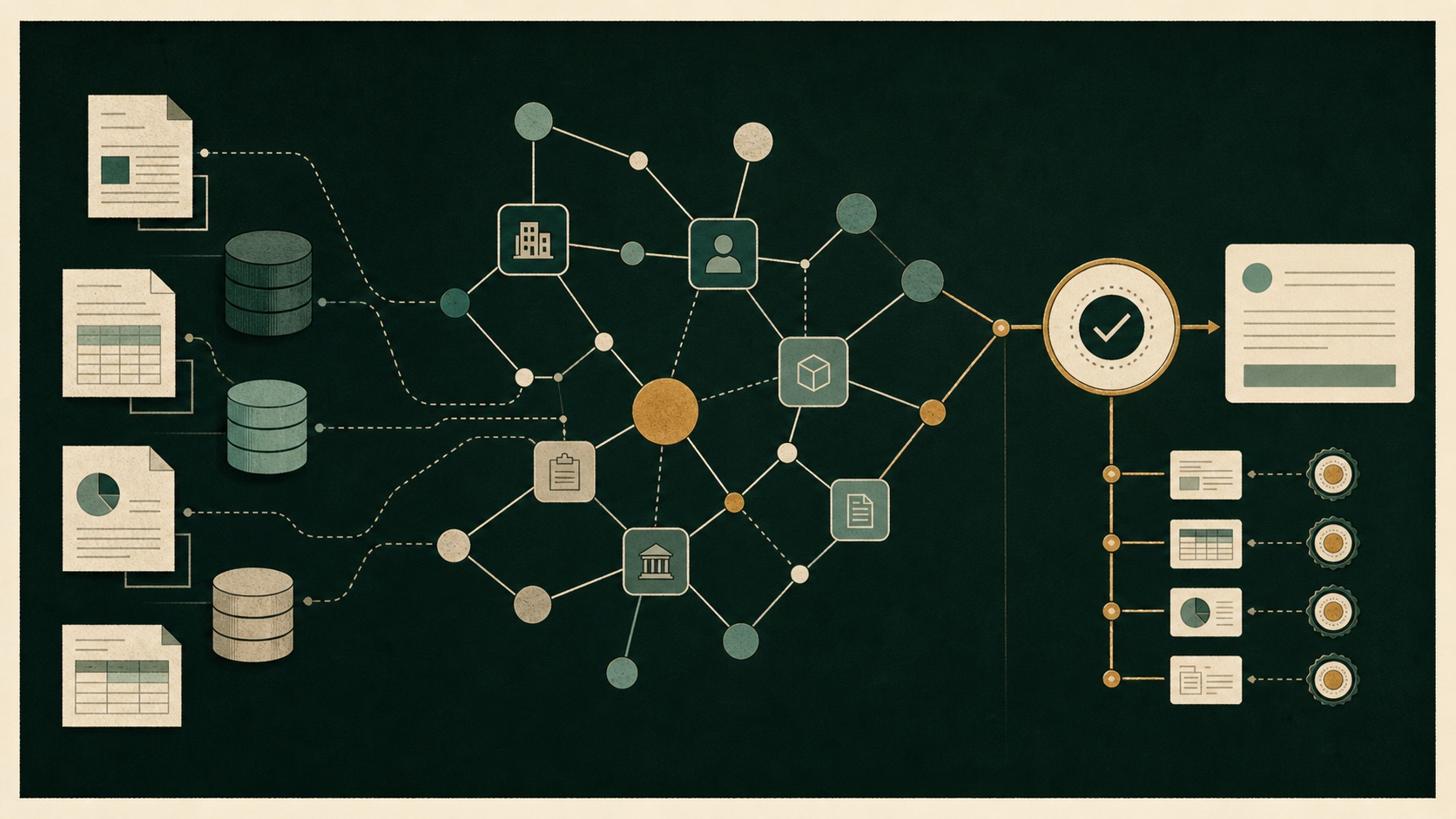
“We already put our company documents into a RAG system. Why would our AI need a graph?”
The short answer
Search finds relevant facts. A graph preserves how they relate.
Vector search can retrieve passages that sound like the question. It does not reliably tell the AI that one company owns another, a policy supersedes an older policy, a service depends on a vendor, or an approval was valid only during a specific period. Graph engineering makes those relationships explicit, testable, and traceable.
Most enterprise AI projects begin by moving unstructured information closer to the model. Documents are split into chunks, converted into embeddings, and retrieved by semantic similarity. That is a useful first system. It helps an AI find language that resembles a user’s question.
The harder questions are rarely about resemblance. They are about structure: ownership, dependency, sequence, authority, impact, and change over time. The answer may cross a CRM record, a contract, a service catalog, an incident, and a project plan. No single passage contains the full path.
This is where graph engineering matters. It turns disconnected records into a governed context layer that both software and people can inspect.
Vector search finds proximity, not dependency
Imagine an executive asks, “Which enterprise customers are exposed if the Atlas identity migration slips?”
A similarity search may return the Atlas project plan, customer notes that mention identity, and a recent status update. The model still has to infer the important connections. Which products use Atlas? Which customers have those products? Which contracts promise a migration date? Which open risks are current? Who owns the response?
A graph can represent those connections directly:
| Entity | Relationship | Business meaning |
|---|---|---|
| Customer | USES → Product | Connects an account to the product capability it depends on. |
| Product | DEPENDS_ON → Service | Exposes the technical path from customer experience to Atlas. |
| Contract | COMMITS_TO → Milestone | Distinguishes a commercial obligation from an internal target. |
| Risk | THREATENS → Milestone | Connects the current delivery risk to the obligation it may affect. |
| Person | OWNS → Risk | Identifies the person accountable for the next action. |
The AI can now retrieve a bounded subgraph and the supporting source passages. Its answer can show the path from migration to service to product to customer, then cite the records behind each important claim.
Graph engineering is broader than GraphRAG
GraphRAG is an important retrieval pattern, but the terms should not be treated as synonyms. Microsoft Research introduced GraphRAG to answer global questions over large private text collections. Its pipeline extracts entities and relationships, detects communities, creates summaries, and uses those summaries during retrieval.
Graph engineering is the larger discipline required to make a relationship layer dependable in production. It includes the domain model, source integration, entity resolution, provenance, temporal history, validation rules, access controls, retrieval design, evaluation, and ongoing maintenance.
Installing a graph database does not create that discipline. Neither does asking a language model to extract every noun and relationship it can find. A noisy graph only gives the AI a more elaborate way to be wrong.
The five parts of a production graph
- Start with a query contract. Write the decisions the AI must support, the paths required to answer them, and the evidence a user should see. Model from real questions, not from a goal to “connect all company knowledge.”
- Define a small domain model. Name the entities and relationships that carry business meaning. Specify direction, cardinality, required properties, and prohibited connections. A narrow graph with clear semantics is more valuable than a universal ontology nobody can maintain.
- Resolve identity across systems. “Acme,” “Acme Holdings,” CRM account 1842, and the billing customer may represent one organization—or they may not. Entity resolution needs stable identifiers, matching rules, confidence thresholds, and a review path for ambiguity.
- Preserve provenance and time. Store which source asserted a relationship, when it was observed, when it was valid, and whether it was extracted, calculated, or approved by a person. Without this, the graph flattens conflicting and obsolete claims into apparent truth.
- Combine retrieval with evaluation. Use graph traversal for explicit relationships and vector search for supporting language. Evaluate the retrieved path, source coverage, freshness, answer accuracy, abstention behavior, latency, and cost—not only whether the final prose sounds convincing.
These parts reinforce one another. Better retrieval cannot compensate for unresolved identities. A clean schema cannot compensate for stale facts. Strong provenance cannot compensate for a graph that models the wrong business question.
Every generated edge is a claim
Language models make graph construction faster because they can extract candidate entities and relationships from unstructured text. Candidate is the important word.
“Atlas blocks the renewal” may be a verified program dependency, a salesperson’s concern, or an outdated sentence copied into three status reports. Those statements should not become equivalent edges.
Source
Which record, passage, event, or system produced the claim?
Method
Was it imported, extracted, calculated, inferred, or approved?
Validity
When did the relationship become true, and when did it stop being true?
Confidence
Can the system act on it, show it with a warning, or only send it for review?
This is also why graph validation belongs in the ingestion pipeline. The system should reject or quarantine impossible structures before they reach an AI response: a contract with no customer, a dependency that points to itself, an approval with no approver, or two “current” policies for the same scope when only one is allowed.
Use a graph when relationships carry the answer
Not every AI product needs a knowledge graph. If users ask straightforward questions answered by one passage, conventional retrieval may be cheaper and easier to operate.
A graph becomes useful when the work depends on one or more of these conditions:
- The answer requires multiple hops across systems or documents.
- Identity must be reconciled across inconsistent names and identifiers.
- Dependencies, ownership, authorization, or lineage affect the decision.
- Users need to inspect the evidence path behind an answer.
- Relationships change over time and the system must distinguish current from historical truth.
Common examples include customer and product intelligence, software dependency mapping, fraud investigation, data lineage, security exposure, supply-chain risk, clinical decision support, and policy compliance. In each case, the relationship is not metadata around the answer. It is part of the answer.
Build the smallest useful graph
A useful first graph does not need to represent the whole company. It needs to answer a small set of valuable questions better than the current system.
- Choose ten questions. Use questions that currently require an experienced person to connect information across multiple sources.
- Model only the required paths. Define the smallest set of entities, relationships, and time rules needed to answer those questions.
- Load authoritative facts first. Start with structured system-of-record relationships. Use model extraction for the unstructured gaps, with provenance and review thresholds.
- Return paths with passages. Give the model the relevant subgraph and the original source text. Give the user the answer, evidence, and uncertainty.
- Test change, not just demos. Measure what happens when names conflict, facts expire, sources disagree, edges disappear, and the question has no supported answer.
Microsoft’s own GraphRAG guidance warns that indexing can be expensive and that domain-specific prompt tuning matters. That is a useful reminder: the goal is not to maximize graph construction. The goal is to spend structure where structure improves a decision.
How this connects to the work I do
Graph engineering sits at the intersection of software architecture, data design, AI delivery, and operating governance. That is exactly why it is difficult to assign to a single tool or team.
I help leadership identify the decisions where connected context can create measurable value, then work backward into the system the business can actually operate. We define the domain boundaries, authoritative sources, identity strategy, security model, retrieval path, evaluation set, and rollout plan before a prototype quietly becomes critical infrastructure.
For the engineering team, that means versioned schemas, repeatable ingestion, validation at system boundaries, observable retrieval, and evidence that survives a model or vendor change. The graph becomes a reusable business asset rather than hidden plumbing inside one chatbot.
Do not begin with the enterprise knowledge graph
“Build a complete map of the company” is an expensive ambition with no finish line. Begin with one decision, one bounded domain, and a small set of questions whose answers matter.
If the graph improves accuracy, traceability, or speed for that workflow, expand it one relationship at a time. If it does not, simplify the architecture. A graph should earn its operational cost.
Do not give AI more context. Give it the right path through context—and the evidence to prove that path is real.
Primary references
- Microsoft Research: From Local to Global — A Graph RAG Approach to Query-Focused Summarization
- Microsoft GraphRAG: open-source indexing and retrieval system
- Neo4j: Knowledge Graph Builder pipeline and entity resolution
- W3C: PROV-O provenance ontology
- W3C: Shapes Constraint Language for graph validation